Agents can now write their own tools, but there is limited research on how an agent should empirically choose which tool edits improve task performance the most. We study this for loco-manipulation: a Spot quadruped must find a payload on a table and walk it to a cabinet to drop it off.
Agentic robots powered by frontier LLMs are increasingly capable of solving complex physical tasks. Tool-calling is an important method for agentic robot control: agents can now write their own tools, but there is limited research on how an agent should empirically choose which tool edits improve task performance the most.
We study this for loco-manipulation with a Boston Dynamics Spot quadruped carrying a 6-DoF Spot Arm, tasked with finding a payload on a table and walking it to a cabinet to drop it off. A refiner agent hill-climbs the robot agent's toolset through local beam search in simulation, statistically gating every proposed edit against a control before it survives to the next generation.
We run three search campaigns and evaluate the resulting toolsets in 220 real-world field trials. Tools refined in simulation transfer: we measure a mean gain of 23% in subtask completion on a pick-and-place task with two objects, and an R² of 0.33 between simulated and real-world toolset performance.
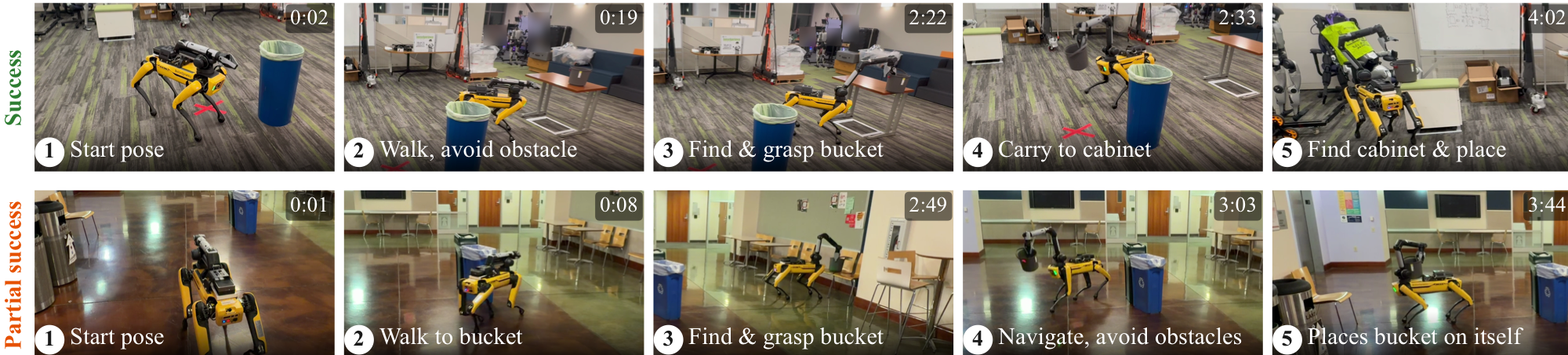
Bucket pick-and-place with Spot. Top: a successful episode in Environment A. Bottom: in Environment B, the robot grasps the bucket and avoids obstacles, but cannot find the target chair and places the bucket on its own back.
A refiner agent reads failure summaries from simulated episodes and proposes up to M edited copies of the robot agent's prompt and tool files per generation.
Every candidate runs on fixed seeds against a control. A one-sided paired sign-flip test decides whether the mean improvement is real; the best K survive.
Statistically significant toolsets are promoted to field trials on the real Spot, with no real-world tuning of the tools in between.
The robot agent is given a system prompt describing the Spot and Spot Arm embodiment, plus high-level tools that call the low-level Spot SDK. Only the prompt and the tools change between generations.
cj = 1 if subtasks 1…j all completed; tj is the time subtask j took; Tj is its target time.
The fraction of the 2n sign-flips of the n paired differences whose sum is at least the observed sum.
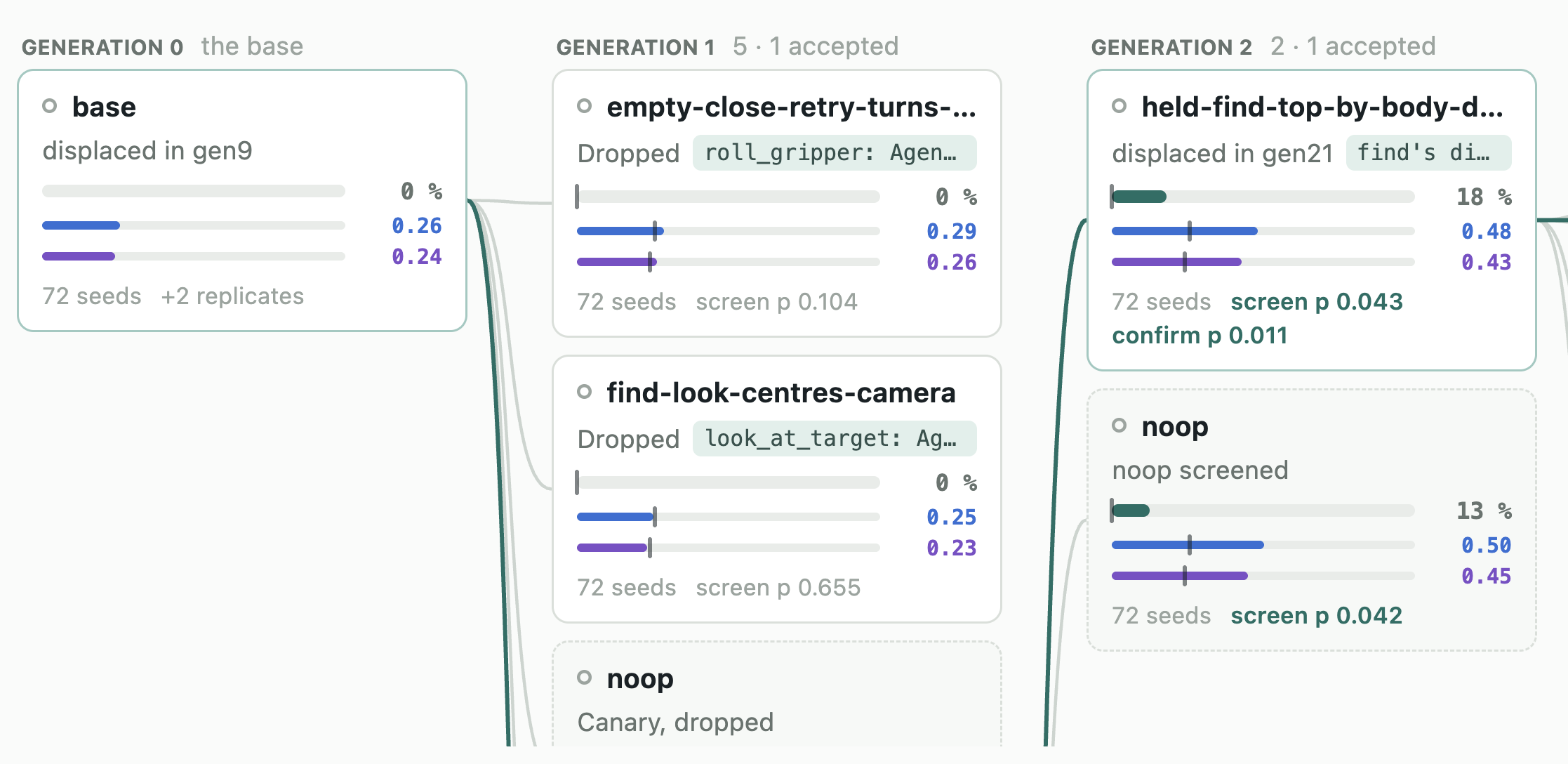
Campaign H2, generations 0 to 2, from our run dashboard.

Each card is one candidate toolset, named for its edit, with its search-seed success and scores. Lines link children to parents; the dark line is the accepted lineage. A no-op control is an unchanged copy of the parent, run to measure noise. In generation 2 the edit held-find-top-by-body passed the screen (p = 0.043) and the confirmation (p = 0.011) and became the new head.
Each campaign searches from the baseline toolset (G0) in its own simulation setup, except for H3, which uses H1's final toolset. Low-fidelity primitive scenes drive early search; a Gaussian-splat reconstruction of our lab, built from iPhone 13 Pro LiDAR scans with the GaussGym pipeline, drives H2 and H3.
Bucket payload only, no inheritance. The first campaign.
Bucket payload; inherits H1's lessons.
Bucket and duffel bag; inherits H1's final tools as G1.
Toolsets: candidates written (field-tested in parentheses). Percentages compare each campaign's last field-tested toolset with the baseline.
We ran 220 field trials in Environment A and 40 more in Environment B. Each toolset is evaluated in 20 trials, 10 carrying a bucket and 10 carrying a duffel bag, split evenly between Gemini 3.8 Live and Qwen3.8-27B as the agent model.
Trials that passed each subtask, of 10 per object. Hover a cell for details.
Sim success (% of seeds with the full mission done) is on the 96 held-out seeds, or on the search seeds for H1 (†); G0's is averaged over the three campaigns. Field score is the mean number of subtasks done, of five, over all 20 trials. H3's G4 and G8 are one toolset, tested once as G8*. All field trials ran in Environment A.
Place succeeded once across the ten campaign toolsets, in H2's G8 with the bucket. The clearest gain is at the pick: duffel-bag picks rose from 2 of 10 for the baseline to 54 of 100 pooled across the ten campaign toolsets, likely from a rule H1 added to measure_grip that turns the gripper 90° when the vision model picks grip points at opposite ends of the handle, which H2 and H3 both copied.
Environment A. A large open cubicle area on carpet, reconstructed by our Gaussian splat; the trash-can obstacle and the payload pose are randomized every trial, and all 220 scored trials ran here. Left: H2's G8 walks around the trash can, re-grasps the bucket by its outer lip after two misses and carries it to the cabinet. Its gripper camera never sees the cabinet, but it places the bucket on it anyway, at 251 s: the only one of the 220 trials to pass all five subtasks. Right: H3's G21 grasps the duffel bag along its long axis on the first attempt, carries it to the cabinet and hovers it over the place spot, but keeps walking, pushes the cabinet away and times out at 300 s.
Same task, same agent model. The baseline grabs the bucket by the handle and lifts it, then drops it on the floor and cannot find it again. H2's G4 grasps the handle, moves into the carry pose and carries the bucket to the cabinet.
Environment B. Two toolsets were also tested zero-shot in a second environment that no simulation campaign has seen, where the cabinet target is replaced with a chair and the payload starts on another chair. Left: H2's G12 avoids an obstacle, re-grasps the bucket after it tips over and carries it to the destination, but cannot find the target chair and sets the bucket on its own back, the same failure as the bottom row of the overview figure. Right: the same toolset grasps the duffel bag on its first alignment, crosses a recycling bin to the destination chair and hovers the arm to place, but finds no surface, loses the chair from view and walks through the chairs until the trial is stopped at 300 s.
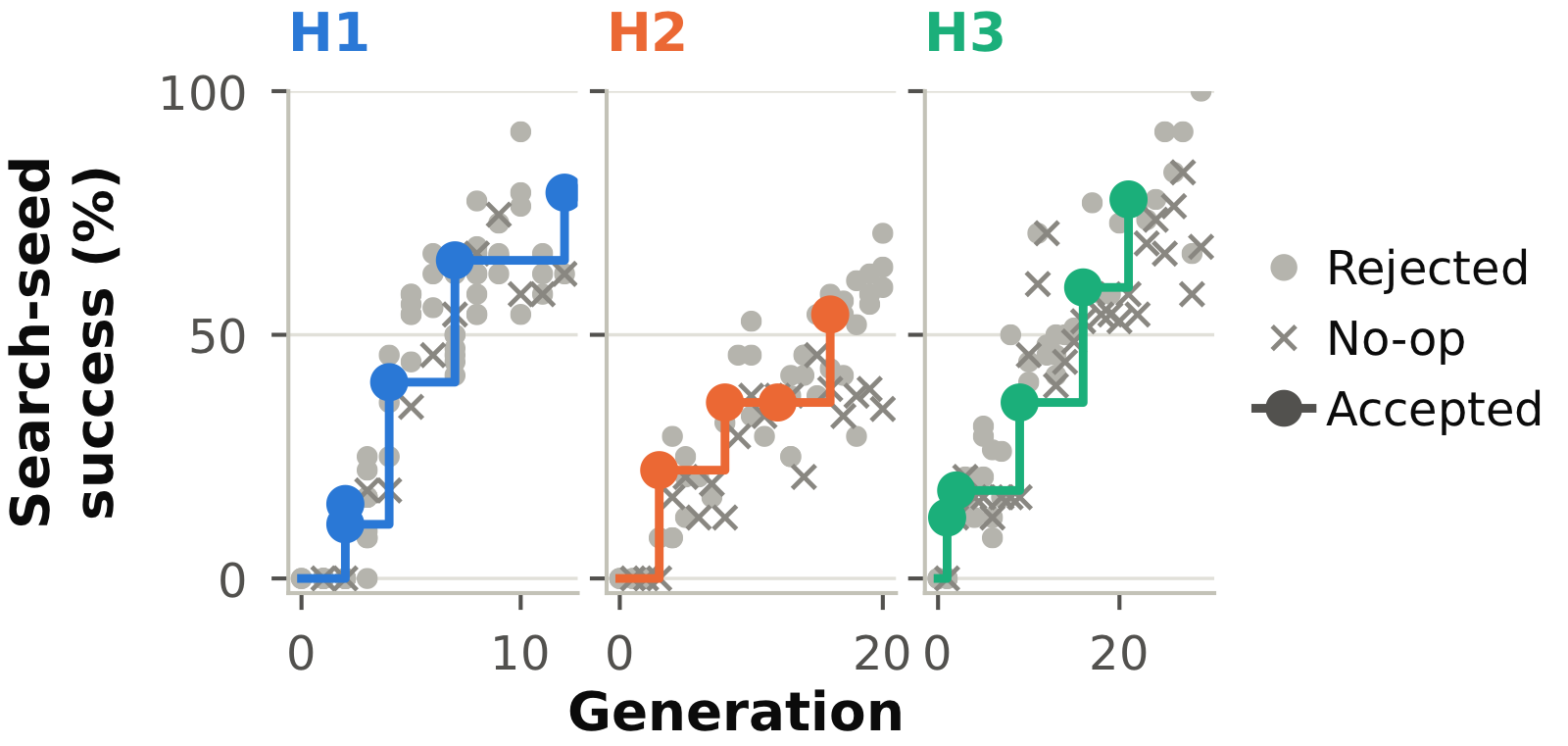
Search-seed success per generation, H1 to H3.

Rejected candidates are gray dots; no-op controls (crosses) are unchanged copies of their parent; colored lines trace the accepted lineage that went on to field testing. Search-seed success climbs within every campaign, from 0% at G0 to as high as 79% (H1), 54% (H2) and 100% (H3) by the final generation shown. (candidates.csv)
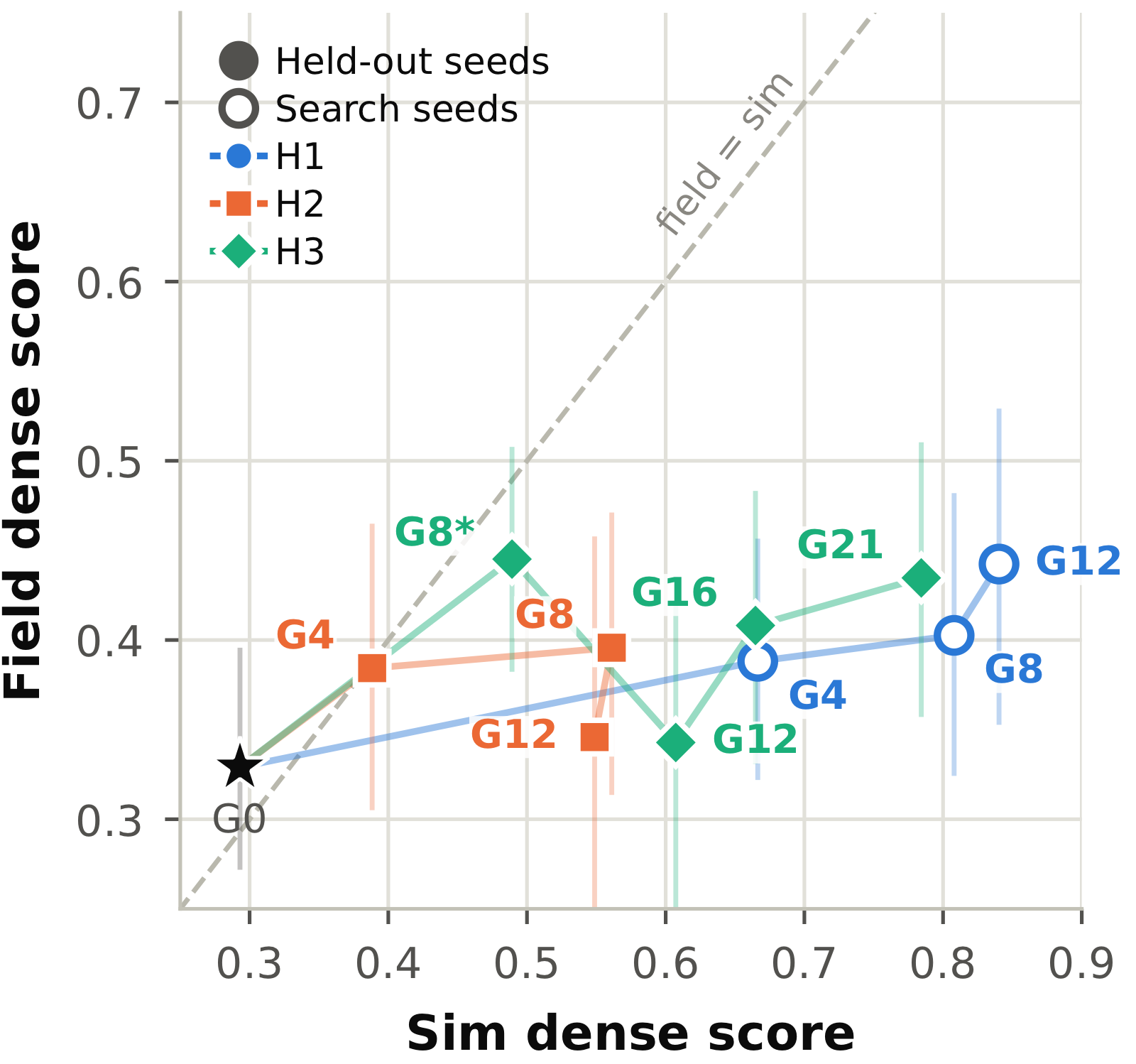
All 11 field-tested toolsets: the baseline and 10 campaign toolsets.

Field dense scores are means with 95% bootstrap intervals; sim dense scores are split into held-out seeds (filled) and search seeds (hollow). Every campaign toolset sits below the dashed "field = sim" line. From the baseline through H1's three field-tested toolsets, every rise in simulation score came with a rise in field score. In H2 and H3, held-out simulation success rose from 0% to as high as 54% while field gains stayed modest.
@misc{tsai-double-t-diner-2026,
title = {Double-T DINER: Deploying Improvements in New
Environments via Refined Tool Transfer},
author = {Tsai, Henry and Huang, Leo and Cantrell, Denae and
Harutyunyan, Narek and Tsai, Hunter and Dong, Maggie and
Jo, David and Tomlin, Claire and Sastry, S. Shankar},
note = {CoRL 2026 Workshop on Sim-to-Real-to-Field:
The Science of Transfer},
year = {2026},
url = {https://www.alphaxiv.org/abs/2611.diner},
}
This work was performed in the FHL Vive Center for Enhanced Reality and was supported by the program "Design of Robustly Implementable Autonomous and Intelligent Machines (TIAMAT)," Defense Advanced Research Projects Agency award number HR00112490425.
We thank our collaborators at Stanford University, Lizzi Yin, Yousef Liang and Marco Pavone, for their support and collaboration. We thank Lizzi in particular for her help with the robot's run-recording tools.
We thank Rosario Scalise for the 3D scan of the duffel bag used in our simulation.
We also thank Jason Pusey, John Rogers, Sean Gart, Jayasuriya Suresh, and all of the staff at the Army Research Laboratory Robotics Research Collaboration Campus for their tireless efforts in building diverse challenges, including the bucket pick-and-place task and outdoor environments, for testing our Spot and evaluating our baseline agent.