Generated motion. Learned interaction.
DreamVLAFrom Generated Human Motions to
Humanoid Vision-Language-Action Policies
1 Princeton University2 University of California, Berkeley
* Equal contribution
The idea
Abstract
Training vision-language-action (VLA) policies typically depends on substantial robot demonstration data, making human teleoperation a costly and cumbersome bottleneck, particularly for whole-body humanoid interaction. Reinforcement learning in simulation offers an alternative for scaling this data, but designing task-specific rewards remains challenging.
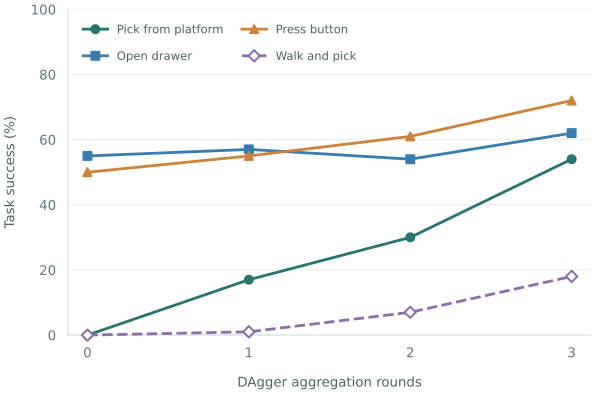
To address this, we propose DreamVLA, which uses generated motion trajectories to guide reinforcement learning (RL) in simulation, converting them into reliable task execution trajectories. These trajectories train VLA models in simulation without new task-specific teleoperation data. Our central contribution is a reference-conditioned DAgger distillation procedure: after a failed learner rollout, we restart the RL expert from a sampled learner state with the same reference suffix and aggregate successful corrective trajectories, addressing the distribution shift left by offline imitation.
We evaluate picking from a platform, opening a drawer, pressing a button, and walking and picking from a platform, with ablations of DAgger iterations, residual RL, and generated dataset scale.
From motion to action
A look at DreamVLA
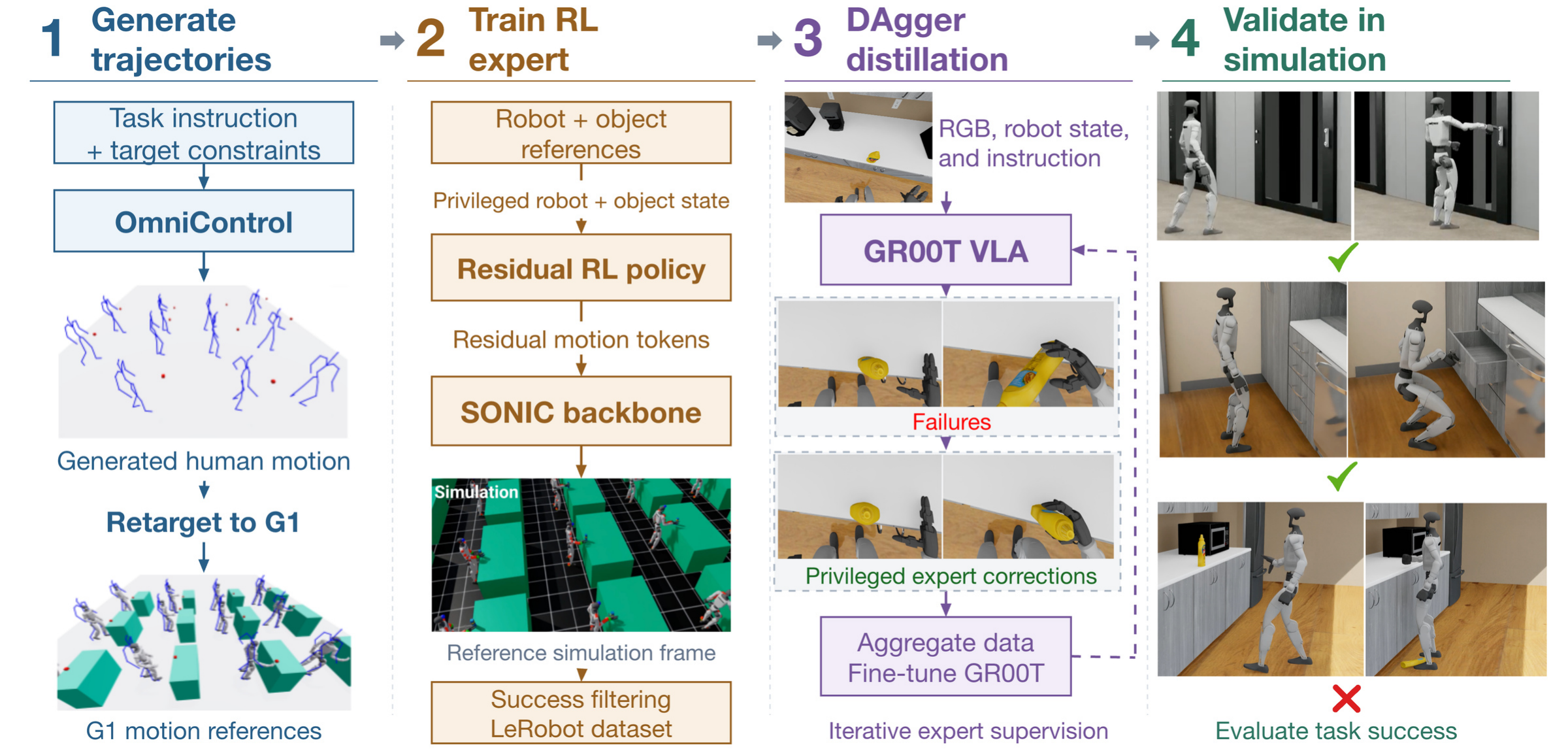
Generated human motions guide a residual RL expert. Successful demonstrations and corrective recoveries train a vision-language-action policy.
Whole-body interaction
Four tasks. One framework.
Clean third-person GR00T rollouts.
Drawer and button episodes available.
Drawer and button videos show selected successful pre-DAgger GR00T rollouts from the 200-reference models, without expert takeover, overlays, or action smoothing. The third-person camera is for visualization only; each policy uses its robot-mounted camera. These clips illustrate behavior, not success rates. Picking videos remain pending. Clip provenance ↗
Learning from more experience
What improves task success?
Reported results across all four tasks.
100 evaluation rollouts per task.
More DAgger rounds, stronger policies
View reported values
| Task / rounds | 0 | 1 | 2 | 3 |
|---|---|---|---|---|
| Pick from platform | 0 | 17 | 30 | 54 |
| Open drawer | 55 | 57 | 54 | 62 |
| Press button | 50 | 55 | 61 | 72 |
| Walk and pick | 0 | 1 | 7 | 18 |
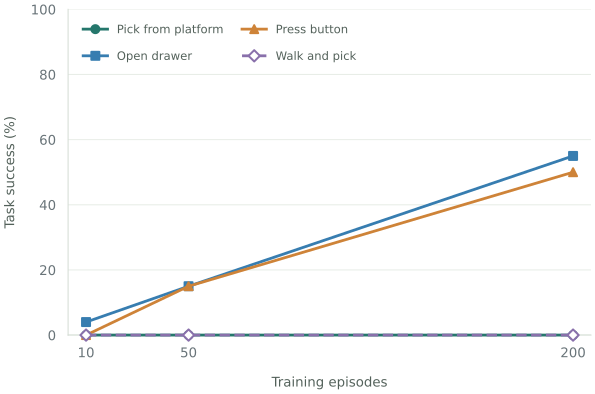
More generated data helps interaction
View reported values
| Task / episodes | 10 | 50 | 200 |
|---|---|---|---|
| Pick from platform | 0 | 0 | 0 |
| Open drawer | 4 | 15 | 55 |
| Press button | 0 | 15 | 50 |
| Walk and pick | 0 | 0 | 0 |
Build on this work
BibTeX
@misc{park2026dreamvla,
  title  = {DreamVLA: From Generated Human Motions to
            Humanoid Vision-Language-Action Policies},
  author = {Park, Kevin and Rasyad, Izat and
            Kalaria, Dvij and Sastry, Shankar},
  year   = {2026}
}